The Textile Design Department, in collaboration with Makerere University in Uganda

Updates

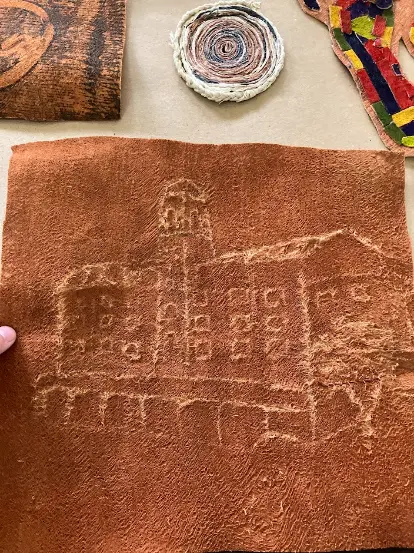
The Textile Design Department, in collaboration with Makerere University in Uganda, held a joint summer course on Bark-Cloth, which culminated with a visit and an intensive collaborative workshop at Makerere University.

In September 2024, The Textile Design Department, in collaboration with the CO-CU-DI Center for Cosmopolitan Cultural Dialogue and with the support of The Shenkar International Center, held  a joint course with the Margaret Travel School of Art and Design, in the College of Engineering, Design, Art and Technology at the University of Makerere in Kampala, Uganda. Makerere University is the leading university in Uganda and among the leading institutions in Africa.

The intensive textile course is a continuation of an ongoing collaboration between the School of Art and Design at Makerere University and the Shenkar Textile Design Department. Notably, this is actually the first in-person collaborative workshop following two joint courses that took place remotely through digital means.

The course dealt with a local traditional raw material called Bark-cloth, a non-woven textile sheet produced from the bark of a Ficus tree in southern Uganda. This material has deep roots in Uganda’s local history and culture, and is of religious, ritual and traditional importance. As a raw material, it has unique sustainable natural characteristics and is a new material for experimentation and research. Added to all of this is the extensive knowledge of the Textile Design Department in textile structures, material development and innovation, and in the non-woven technology taught in the department.

During the course, the students had the opportunity to become familiar with traditional textile crafts, among them, bark textiles, to experience the production process of the material through all its stages: from the planting of a local Ficus tree, through the extraction of the raw material and its processing into cloth, a process that requires time, knowledge and skill unique to the local culture. On campus, the students worked together in mixed groups and experienced joint practical research, where they learned about the material and the inherent potential in it for  new and original work. The students presented the results of the research in a joint festive presentation. They gained an extremely important added value of exposure to local material culture and a new learning experience, which included workshops and tours, meetings with artists and working together with students from Uganda.

3rd and 4th year students participated in the traveling course, which was jointly led by Shira Shoval, a senior faculty member in Shenkar’s Textile Design Department, and Dr. Venny Nakazibwe from Makerere University. Dr. Nakazibwe, a former Dean of the School and Deputy Head of the College of Engineering, Design, Art, and Technology at Makerere, is one of the world’s leading researchers in Ugandan bark textiles.

Thank you to each and every one of those who initiated, accompanied, guided, provided knowledge and made this important journey possible:

Micky Keidar, head of The Shenkar Textile Design Department;

Shira Shoval, course leader on behalf of Shenkar;

Tamar Dekel, the Initiator, guide, organizer and manager of the journey.

 CO-CU-DI Center – an international development organization that is based in Israel and is responding to one of the main challenges of entrepreneurs in developing communities: limited access to the skills and infrastructure required for development by local change agents. The organization aims to build bridges through knowledge-sharing programs, provide skills and infrastructure to local actors and promote social action;

Dr. Idit Toledano and The Gallery for African Studies who aims to offer the Israeli public new and diverse ways of looking at the various African cultures and their artistic richness. The gallery raises questions about common Western concepts such as art, modernism, authenticity, and even who is an artist. Thus, the gallery serves as a laboratory for examining ideas as much as the artworks themselves;

The Shenkar International Center which strives to integrate international, intercultural and global dimensions into the academic training of students, reflecting the essential educational priorities of the 21st century.

whatsapp
For advice and more details
whatsapp
Contact
Want to study in Shankar? Fill in your details and we will contact you