Bark Cloth – Sustainable Textile Course

סטודנטים

Bark Cloth – Sustainable Textile Course

A collaboration between Shenkar Engineering, Design & Art (Israel), Makerere College of Engineering, Design, Art & Technology (Uganda) and CoCuDi Center (Israel)

Students and faculty from the Department of Textile Design at Shenkar participated in a Sustainable Textile Course in Kampala, Uganda. After several years of virtual collaboration, this is the second year that this course is taking place physically in Uganda, where the Mutuba tree grows. The Mutuba is a vital East African fig tree, and the source for Bark Cloth. The Mutuba bark cloth is an ancient, non-woven, environmentally friendly textile produced by crushing the inner bark of trees into flexible sheets. Traditionally used for clothing, bedding and ceremonial items, this fabric is known for its earthy, textural and durable properties.

The students and faculty participated together, for eight intensive days, in a multidisciplinary design studio, which explored bark cloth as a traditional material that can be used in contemporary design. They experienced field-based learning, worked in handcraft-based workshops and material experiments, conducted in-depth materials research, and developed new products rooted in Ugandan cultural heritage, while collaborating cross-culturally.

The students worked in six mixed international teams, which developed functional 3D products from tree bark fabric, exploring folding, structural reinforcement, connection systems, coating and surface finishing techniques and inspired by origami, folded geometric shapes, botanical forms and more. They explored the transition between 2D and 3D, conducted structural experiments, tested durability, preservation and functional performance, brought together craft and industry, raising questions and finding solutions for cultural responsibility in the use of materials.

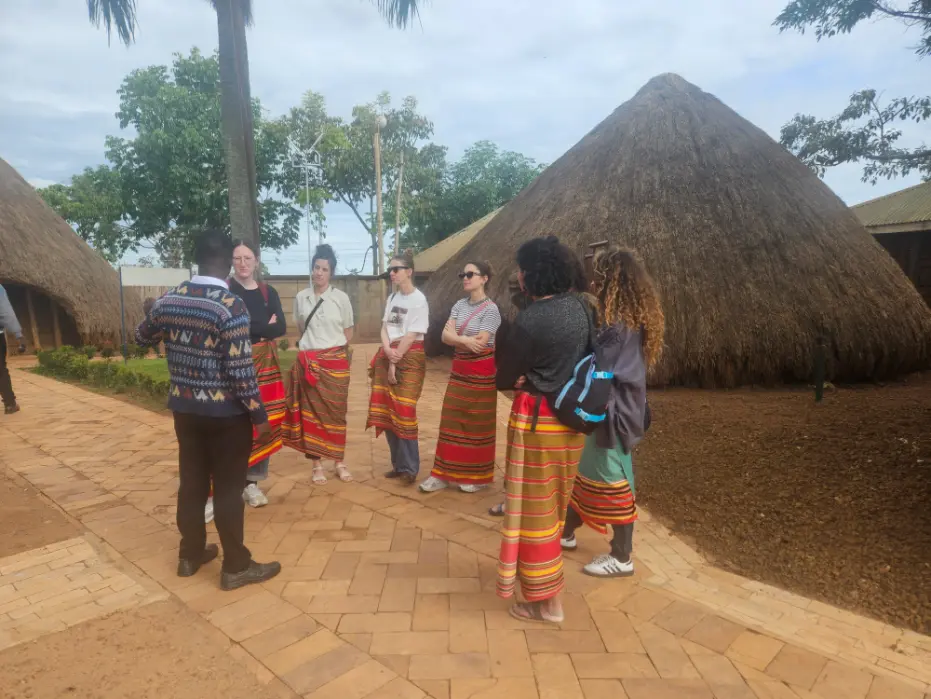
The intensive course deliberately emphasized research and studio experience combined with, and equally important, cultural exposure: field studies, cultural learning, visits to craft markets, participation in workshops on craft making using local materials such as palm leaves, and encounters with local artisans. These grounded the design process in a historical, social, and environmental context.

What does the future hold?

Bark fabric behaves differently than conventional fabric, it requires collaboration with the material rather than forcing a shape. Structural success depends largely on hardening and preparation methods, on techniques for connecting the inner lining to the outer shell, which require research, on the scale that affects stability and functionality, and on the quality of the finish that dramatically affects durability and aesthetic value.

The results demonstrate strong potential for continued research into bark fabric as a contemporary and natural design material with cultural integrity, and the teams suggested future research and development directions in the areas of natural preservation treatments, hardening and structural reinforcement materials, the integration of mixed media (beads, linings, layering systems), ergonomic carrying systems, extended dimensions and weight bearing capacity, sustainable use of material residues, and more.

The project encouraged intercultural collaboration, and as the students said, “It was about material design, but equally, about human connection.”

Thanks to

CoCuDi Center for the practice based intercultural development model and for accompanying the project in all its aspects from the idea stage to the ‘slides’ stage.

Shenkar Textile Design Department for a longstanding and deep partnership, commitment and enthusiasm that has not faded over the years.

Shenkar International Center for supporting the project.

whatsapp
For advice and more details
whatsapp
Contact
Want to study in Shankar? Fill in your details and we will contact you